Vacation Rental Fire Safety Checklist: Alarms, Extinguishers, Exits, and Guest Instructions

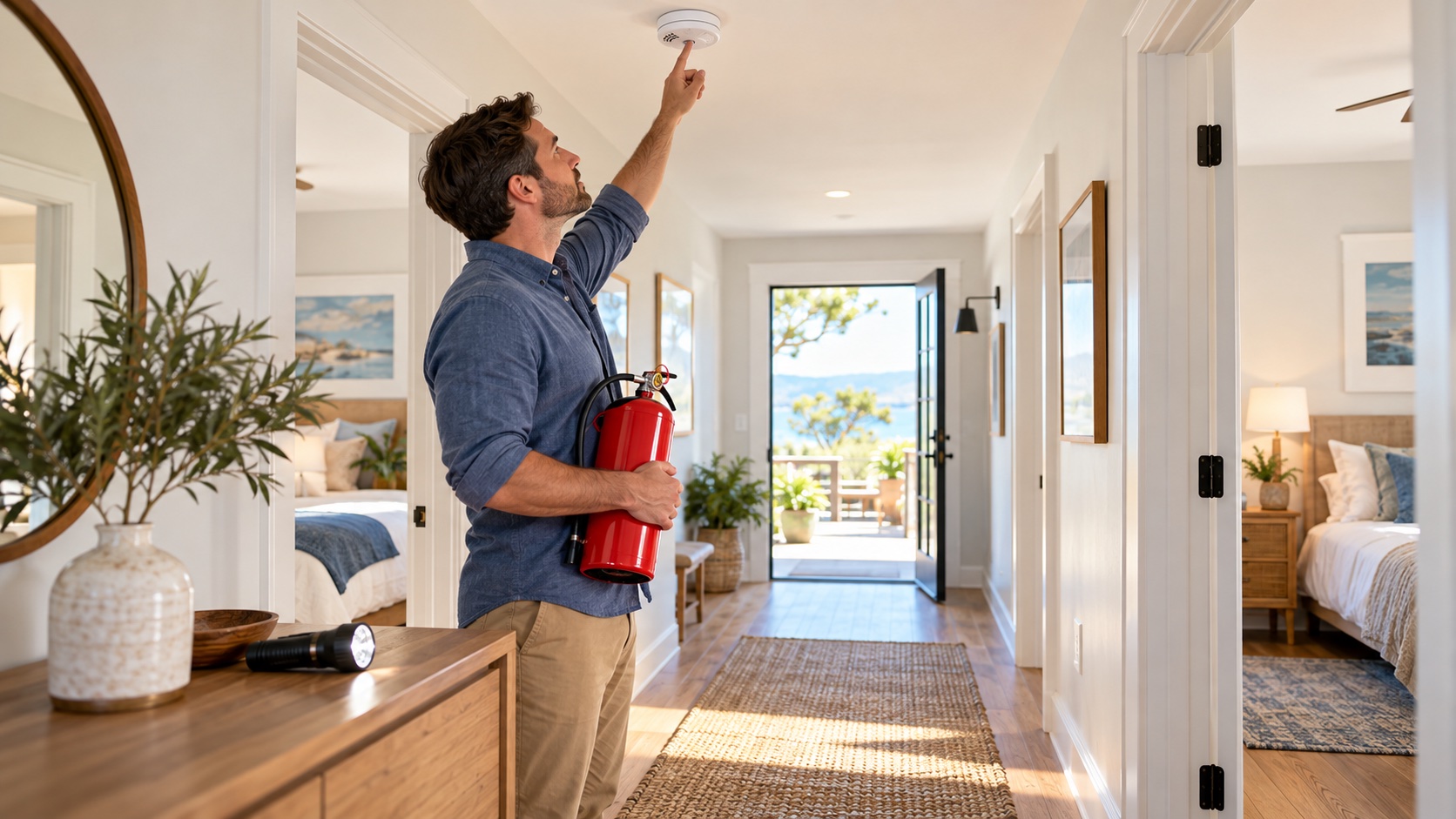
A vacation rental fire safety checklist should verify detection, escape, suppression, guest instructions, and documented testing before every stay. The exact equipment and placement must follow local fire and building codes, but every host needs a repeatable process that confirms guests can recognize danger and leave safely.
This guide covers smoke and carbon-monoxide alarms, exits, extinguishers, cooking and heating hazards, electrical risks, inspection records, and guest communication. It complements—not replaces—a professional fire-safety inspection.
Why vacation rentals need a specific fire plan
Guests sleep in an unfamiliar layout and may not know the address, alarm sound, exit route, or outside meeting place. A host must translate the property’s fire protection into simple actions that work at night, during a power loss, and when the normal exit is blocked.
The U.S. Fire Administration’s short-term rental fire-safety guidance recommends working smoke alarms in each sleeping room, outside sleeping areas, and on every level, plus carbon-monoxide alarms on every level. Local rules may be stricter or different.
Start with local requirements and professional advice
Identify the authority responsible for rental, fire, building, and occupancy requirements. Confirm permits, inspection frequency, alarm type, interconnection, power source, extinguisher rating, emergency lighting, sleeping-room rules, and whether posted plans are required.
Use licensed professionals for electrical, fuel-burning, sprinkler, alarm, fireplace, and code work. Do not copy equipment placement from another property because layout, jurisdiction, fuel sources, and occupancy differ.
Verify smoke alarms
Map every alarm by room or zone. Record manufacturer, model, installation date, power source, test method, and replacement guidance. Test as the manufacturer directs and replace any unit that fails, is damaged, painted, missing, or past its service life.
Do not remove or disable an alarm to stop nuisance activation. Investigate cooking smoke, steam, placement, ventilation, contamination, battery condition, or an unsuitable alarm type with a qualified professional.
Verify carbon-monoxide protection
Carbon monoxide can be produced by fuel-burning appliances, fireplaces, generators, grills, and vehicles. Install and maintain alarms according to code and manufacturer instructions. Explain that an alarm requires immediate action, not ventilation experiments by the guest.
Keep combustion appliances inspected, vented, and unobstructed. Never place a generator, grill, camp stove, or fuel-burning heater inside the home, garage, or near openings. Connect outage procedures to the vacation rental emergency plan.
Create two ways out where required and feasible
Walk every sleeping room and occupied area as a first-time guest. Confirm doors and escape windows open without hidden keys, blocked paths, stored furniture, or complicated instructions. Do not advertise a room as a bedroom when it does not meet applicable requirements.
Mark an outside meeting place a safe distance from the building. Guests should call emergency services from outside and must not re-enter for luggage, pets, or valuables.
Place and maintain fire extinguishers
Select the type, size, number, mounting, signage, and service schedule under local code and professional guidance. Extinguishers should be visible and reachable near a safe exit path—not hidden behind the likely source of fire.
Teach guests that an extinguisher is for a small, contained fire only when they have a clear exit and feel safe using it. Evacuation and emergency services take priority. Record gauge condition, seal, damage, obstruction, and professional service dates.
Control kitchen and cooking hazards
- Keep combustible items away from cooking surfaces.
- Provide stable cookware and appliance instructions.
- Confirm range controls and markings are legible.
- Clean grease from hoods, filters, ovens, and grills.
- Secure or remove damaged small appliances.
- Explain that cooking must not be left unattended.
Do not tell guests to use water on a grease fire. Follow authoritative local guidance and provide equipment appropriate to the kitchen.
Inspect heating, fireplaces, and outdoor fire features
Have fireplaces, chimneys, heaters, furnaces, and fuel systems inspected and maintained. Provide guards, tools, safe clearances, and exact operating restrictions. If a feature cannot be managed safely by unfamiliar guests, disable access and update the listing.
For grills and fire pits, define the permitted location, weather restrictions, fuel storage, supervision, extinguishing procedure, and local burn rules. Never place a grill under an overhang or near doors, windows, dry vegetation, or combustible surfaces unless the installation is specifically designed and approved for it.
Reduce electrical fire risk
Remove damaged cords, hot outlets, loose plugs, overloaded adapters, and unapproved extension-cord setups. Provide enough accessible outlets so guests do not improvise. High-load appliances and EV charging require suitable circuits and professional installation.
Keep electrical panels labeled and accessible to authorized responders, but prevent guest tampering. Repeated breaker trips, burning odor, buzzing, discoloration, or heat require qualified investigation.
Write guest instructions that work under stress
Provide the property address, emergency number, exit routes, meeting place, alarm meaning, and a direct instruction to leave immediately. Keep the language short and use diagrams where required. Place information where guests will see it and include it in the digital guide.
Do not overload emergency instructions with maintenance details. The first steps should be unmistakable: alert others, leave by the safest route, stay outside, and contact emergency services.
Build a testing and documentation routine
Create monthly or jurisdiction-specific inspections in addition to turnover visual checks. Record device identity, test date, result, battery or unit replacement, extinguisher condition, blocked exits, staff initials, and corrective action.
After any alarm, fire, smoke event, renovation, appliance change, or occupancy change, reassess the system. Use the vacation rental inspection checklist to connect findings to verified closure.
Example pre-arrival fire-safety check
- Confirm no alarm is missing, covered, damaged, or chirping.
- Verify exits and escape windows are clear and functional.
- Check extinguishers are present, visible, and serviceable.
- Remove combustibles from cooking and heating equipment.
- Inspect cords, outlets, grills, fireplaces, and fuel storage visually.
- Confirm the address and emergency instructions remain accurate.
- Document exceptions and keep the property offline until critical issues close.
Common fire-safety mistakes
Divide inspections by frequency and competence
Not every safety check belongs in a turnover. Create several layers. Cleaners can identify missing devices, blocked exits, damaged cords, or a chirping alarm. A trained manager can complete scheduled functional checks. Licensed professionals and fire authorities handle work that requires technical knowledge, certification, or code interpretation.
A practical schedule may include:
- Every turnover: visual condition, clear exits, present extinguishers, no warning chirps, and no obvious cooking or electrical hazard.
- Scheduled host check: documented alarm testing, emergency-light inspection, address visibility, and review of supplies.
- Professional service: alarm systems, extinguishers, sprinklers, fireplaces, chimneys, fuel equipment, and electrical work at required intervals.
- Event-driven check: after an alarm, smoke report, power surge, water event, renovation, equipment replacement, or guest interference.
The actual frequency must follow law, manufacturer requirements, authority instructions, and professional advice. The value of the model is ownership: each task belongs to someone qualified to perform it.
Review the property room by room
Bedrooms and sleeping areas
Confirm alarms, egress, door operation, portable-heater restrictions, and clearance around lamps and chargers. Verify that bunk beds, converted rooms, lofts, and sofa beds do not create an occupancy or escape problem. A beautiful room is not a lawful sleeping room merely because a bed fits inside.
Kitchen
Check range controls, hood, grease buildup, appliance cords, clearance, extinguisher access, and combustible storage. Provide instructions for unusual induction, gas, or solid-fuel equipment. Replace unreadable labels rather than relying on a digital guide during an emergency.
Laundry and utility rooms
Clean dryer lint components under manufacturer guidance, inspect flexible connections, keep equipment clear, and prevent guest storage around mechanical systems. Investigate hot surfaces, odors, staining, or repeated breaker trips.
Exterior and parking
Keep the address visible to responders, preserve apparatus access, manage grills and fire pits, and control fuel storage. Check whether parked vehicles can block an exit, hydrant, gate, or emergency path.
Prepare for guests with different needs
Evacuation information should account for children, older guests, hearing or vision disabilities, and mobility limitations without making assumptions about a person’s abilities. Accurately describe stairs, exits, alarm features, and accessible routes so guests can decide and request reasonable adjustments.
Visual or vibrating alert equipment may be required or useful in some properties. Consult fire-safety and accessibility professionals. Do not market the home as accessible based on one device alone.
Example fire-safety incident workflow
A guest reports that an alarm sounded briefly near the kitchen and stopped. The host asks everyone to leave and call emergency services if smoke, heat, gas odor, illness, or continuing alarm is present. A local responder checks the property; the host does not tell the guest to remove the alarm battery. The event, device, cooking activity, and responder findings are documented.
If the cause is nuisance activation, a qualified person evaluates placement, ventilation, contamination, and device type. The home returns to service only after the alarm and affected systems are verified. The resolution is then added to the maintenance record and the procedure updated.
Measure the fire-safety program
Track overdue tests, failed devices, blocked exits, recurring nuisance alarms, professional service completion, staff training, and time required to close critical defects. Do not use a zero-incident history as proof that controls work. Leading indicators—completed inspections and corrected hazards—are more useful.
Review any guest question about alarms or exits. Repeated questions may show that the listing or house manual is unclear. Make safety information easy to find without turning it into promotional language.
- Testing alarms without recording which device was tested.
- Relying only on a cleaner’s visual inspection.
- Hiding extinguishers in locked cabinets.
- Blocking exits with furniture or owner storage.
- Using bedrooms that do not meet local requirements.
- Allowing generators or grills near openings.
- Ignoring recurring nuisance alarms or breaker trips.
- Providing long instructions without a clear evacuation action.
Vacation rental fire safety checklist
- Confirm permits, codes, occupancy, and inspection obligations.
- Map smoke and carbon-monoxide alarms.
- Test and replace devices under approved procedures.
- Verify two safe exit options where required.
- Keep paths, doors, and escape windows operable.
- Install and service appropriate extinguishers.
- Inspect cooking, heating, electrical, and outdoor fire features.
- Post the address, exits, meeting place, and emergency number.
- Train cleaners and co-hosts to escalate critical findings.
- Record tests, repairs, replacements, and professional service.
Frequently asked questions
How often should smoke alarms be tested?
Follow local law, inspection requirements, and manufacturer instructions. Add a visual check before stays and maintain a documented testing schedule rather than relying on memory.
Does every vacation rental need a carbon-monoxide alarm?
Requirements depend on jurisdiction and fuel sources, but carbon-monoxide risk deserves professional assessment. The U.S. Fire Administration recommends alarms on every level of a short-term rental.
Where should an extinguisher be placed?
Placement and rating should follow local code and professional guidance. It should be visible, accessible, and positioned so a person can keep a safe exit behind them.
Can hosts use candles for outages?
Battery-powered lighting is safer. Ready.gov advises using flashlights and lanterns during outages rather than relying on open flames.
Should the host provide an evacuation diagram?
Provide one when required and whenever it materially improves understanding. Keep it property-specific, legible, and consistent with the real layout.
Final recommendation
Fire safety must be verified, not assumed. Map every device, inspect every exit, document testing, and make guest actions obvious. Treat missing detection, blocked escape, electrical warning signs, or unsafe fuel equipment as reasons to stop hosting until corrected.
Ask the local fire or building authority and qualified professionals to review the property. Then turn their requirements into a repeatable inspection that staff can complete and prove.
Artigos Relacionados



Sobre o Autor
