How to Create a Vacation Rental Inspection Checklist

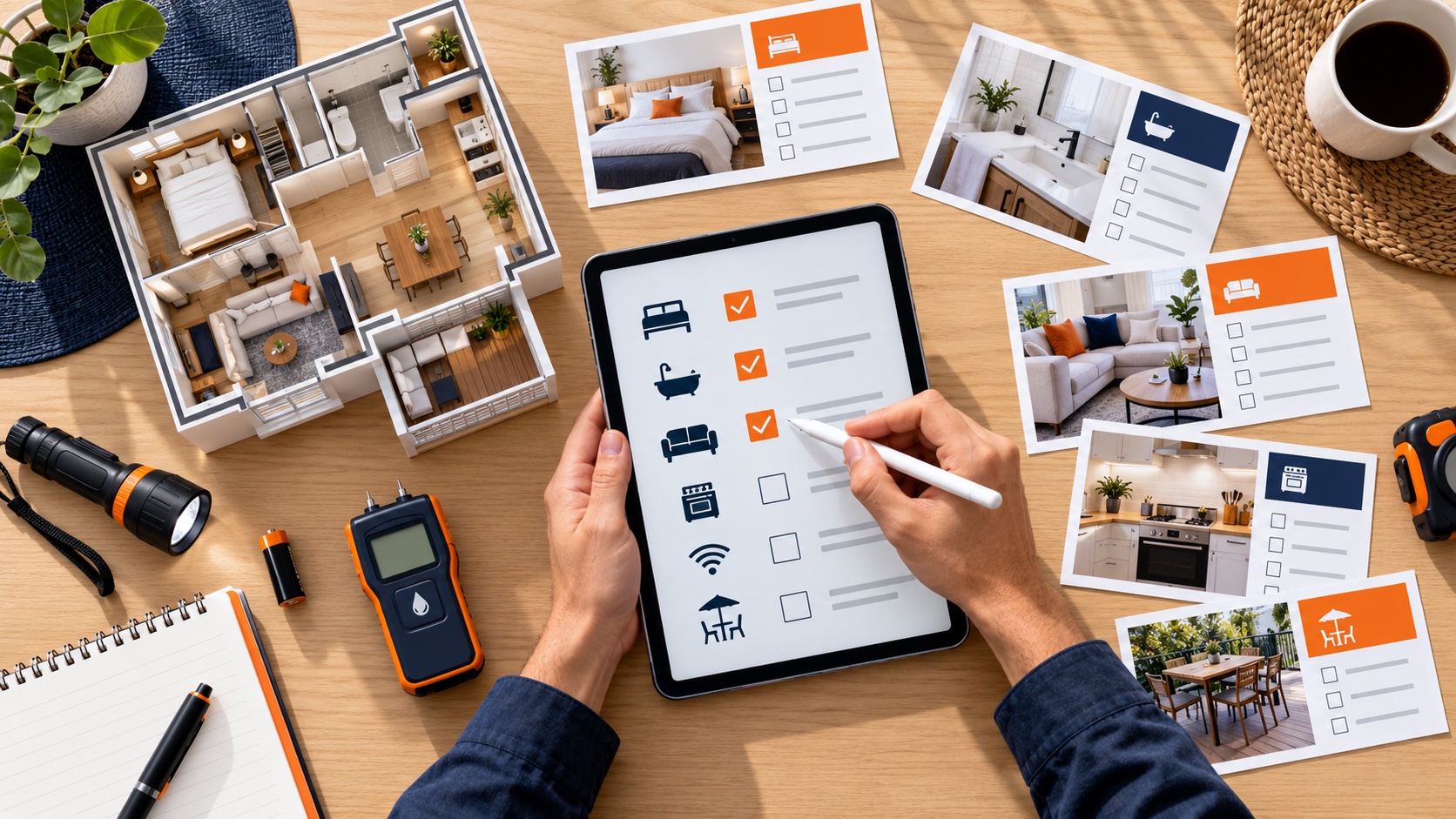
A vacation rental inspection checklist is a property-specific standard used to verify that the home is safe, clean, functional, accurately presented, stocked, and ready before a guest arrives. It is different from a cleaning list: cleaning describes work to perform, while inspection independently confirms the result and identifies exceptions.
This guide shows how to build a checklist by room and risk level, choose evidence requirements, assign responsibility, prevent checklist fatigue, and connect failed items to maintenance and guest communication.
What is a vacation rental inspection checklist?
A vacation rental inspection checklist is a controlled list of conditions that must be verified at defined moments: before arrival, after departure, during periodic maintenance, or after an incident. Each item should have a clear standard, an owner, and an action when it fails.
A useful checklist answers five questions:
- What exactly must be checked?
- What does “pass” look like?
- Who is qualified and responsible to verify it?
- What evidence is needed?
- What happens when it fails?
Airbnb’s safety requirements for homes say hosts must maintain a safe space, address known hazards, maintain listed detectors, and comply with applicable laws. An inspection checklist helps operationalize those responsibilities, but it does not replace legal inspections or qualified technical work.
Cleaning checklist versus inspection checklist
Cleaning is production; inspection is verification. The cleaning checklist tells the team to wash linens, sanitize appropriate surfaces, remove waste, reset rooms, and replenish supplies. The inspection checklist asks whether the final condition meets the property standard.
The same person may complete both tasks in a small operation, but the roles should remain conceptually separate. Otherwise “I cleaned it” becomes “I verified my own work” without a deliberate second look.
For high-risk, high-value, or frequently missed items, independent verification is stronger. That can be a co-host, lead cleaner, inspector, manager, or timestamped photo reviewed remotely.
Choose the inspection types
Pre-arrival readiness inspection
This final check confirms that the home guests will enter matches the listing and the reservation. It covers access, cleanliness, utilities, comfort, safety devices, critical amenities, inventory, and visible damage.
Post-checkout condition inspection
This check records the condition before cleaning moves or discards evidence. It identifies lost items, damage, excessive cleaning, maintenance, safety concerns, and inventory changes. If a potential claim exists, preserve relevant evidence and follow the process in the Airbnb damage claims guide.
Periodic deep inspection
Some conditions do not need verification at every turnover. Schedule periodic checks for furniture stability, sealants, drainage, appliance condition, pest entry points, filters, exterior surfaces, stored supplies, and wear that develops gradually.
Seasonal inspection
Prepare for heating, cooling, storms, freezing conditions, wildfire, heavy rain, pool seasons, or long vacancies according to local risk. The correct list differs substantially by property and climate.
Incident or repair inspection
After a leak, outage, complaint, repair, or safety event, verify both the immediate correction and any affected adjacent systems. A repaired pipe may still leave moisture damage; a replaced lock may require updated codes and guest instructions.
Build the checklist from the guest journey
Walk the property in the order a guest experiences it. Begin with approach and access, then entry, common areas, kitchen, bedrooms, bathrooms, amenities, exterior spaces, and departure. This reveals gaps that a room list alone may miss.
Use the listing as a second source. Every advertised amenity, bed, view, workspace, accessibility feature, parking arrangement, and safety disclosure creates an expectation that should be verified where practical.
Airbnb’s host ground rules emphasize listing accuracy, cleanliness, reliable check-in, and timely communication. The inspection should verify those promises rather than an abstract idea of quality.
How to write a checkable standard
Vague item: “Check bathroom.”
Checkable item: “Shower glass, drain, fixtures, floor edges, toilet, mirror, and vanity are visibly clean; water drains; hot and cold controls function; no active leak or odor is present; towels and guest supplies match the reservation standard.”
A strong item uses observable conditions. Avoid words such as “nice,” “good,” or “fine” unless a separate standard explains them. When dimensions, temperatures, chemical levels, or legal requirements matter, use the applicable official or professional standard rather than inventing a threshold.
Risk-tier the checklist
Not every failed item has the same consequence. Assign a response tier:
- Critical: potential life safety, security, legal, habitability, or serious health issue. The property is not released until resolved or properly evaluated.
- Guest-blocking: access, essential utility, required bed, major cleaning, or advertised core amenity is unavailable. Resolve before arrival or communicate and manage the reservation.
- Service defect: the stay can proceed, but the standard is not met and corrective work is required.
- Observation: wear or trend to plan, document, and monitor.
This prevents a missing decorative cushion from receiving the same escalation as a blocked exit or water leak.
Room-by-room vacation rental inspection checklist
Exterior, parking, and approach
- Address and entrance are identifiable according to listing instructions.
- Parking access, permits, gates, and lighting match the reservation.
- Walkways and steps are clear of new hazards.
- Railings, decks, balconies, and exterior furniture show no obvious unsafe condition.
- Trash and recycling areas are clean, closed, and usable.
- Pool, hot tub, grill, fire feature, and outdoor equipment are checked by the appropriate person.
Entry and access
- The assigned code, key, fob, lockbox, gate, and backup method work.
- Previous guest access has been removed according to policy.
- Entry instructions match the actual door and route.
- Doors close, latch, and lock without unusual force.
- The entry is clean, lit, and free from trip hazards.
Use the smart-lock guide to define code lifecycle, batteries, connectivity, and fallback access.
Living and dining areas
- Floors, surfaces, seating, dining furniture, and high-touch areas meet the cleaning standard.
- Furniture is stable and arranged as shown or described.
- Lighting, blinds, climate controls, and remotes function.
- No visible damage, stain, odor, pet residue, or left item remains unresolved.
- Windows and exterior doors operate safely.
- Guest information is current and not mixed with outdated cards.
Kitchen
- Food-contact surfaces, sink, appliances, cabinets, dishes, and cookware are clean.
- Refrigerator and freezer are operating and free from abandoned guest food according to policy.
- Cooktop, oven, microwave, dishwasher, coffee equipment, and advertised appliances function.
- Water runs, drains, and shows no visible leak.
- Essential cookware and tableware match maximum occupancy.
- Consumables meet the property’s par level and approved product standard.
- Waste and recycling are empty, clean, and correctly lined.
Bedrooms
- Each advertised bed and sleeping arrangement matches the listing.
- Linens are clean, dry, undamaged, and correctly fitted.
- Mattress and pillow protectors are present where required by the property standard.
- Under-bed, closet, drawer, and headboard areas are inspected for left items and evidence of pests.
- Bed frames, bunks, ladders, and furniture show no obvious instability.
- Lights, outlets, blinds, fans, climate, and door hardware work as intended.
Bathrooms
- Toilet, shower, tub, sink, mirror, floors, edges, and fixtures meet the cleaning standard.
- Water drains and hot and cold controls work.
- No active leak, mold-like growth, sewage odor, or damaged seal is visible.
- Towels, bath mats, toilet paper, soap, and advertised toiletries meet par.
- Exhaust ventilation and lighting function.
- Grab bars or accessibility features are secure and match the listing.
Laundry and utility areas
- Machines are empty, clean, and functional if advertised.
- Lint is removed according to the equipment procedure.
- Hoses, drains, pans, and nearby surfaces show no visible leak.
- Chemicals are labeled, stored correctly, and secured from guests as appropriate.
- Electrical panels, water heaters, and mechanical equipment are unobstructed where required.
Safety and emergency readiness
- Smoke and carbon monoxide alarms are present, listed accurately, and tested on the required schedule.
- Fire extinguisher, first-aid kit, emergency contacts, and exit map are present and maintained where required.
- Exits and escape routes are not blocked.
- Pool barriers, child-safety devices, and hazard disclosures match the property and local rules.
- No exposed wire, active leak, gas odor, unstable structure, or other known hazard is left unresolved.
Connect these checks with the vacation rental emergency plan. Safety equipment should be maintained according to law, manufacturer instructions, and qualified professional advice.
Decide when photos are required
Requiring a photo for every item creates clutter and can encourage rushed, meaningless evidence. Require photos when they prove a critical standard, establish pre-arrival condition, document a failure, show a repair, or support a later decision.
A useful photo should be current, property-specific, framed widely enough for context, and clear enough to show the condition. Avoid photos that expose guest documents, access codes, personal belongings, or unnecessary personal information.
For recurring items, define the required angle. “Photo of thermostat” may not show the room, mode, or error. “One photo showing thermostat display and adjacent wall, with no guest information visible” is more reliable.
Create a failed-item workflow
A checklist without an escalation path is only a record of problems. When an item fails, the system should create or assign a task with priority, owner, evidence, target time, and verification requirement.
- Record the observed condition without guessing the cause.
- Classify the risk and determine whether the property can be released.
- Assign the correct cleaner, technician, vendor, or manager.
- Decide whether the arriving guest must be informed.
- Document the correction and cost where relevant.
- Verify the completed work independently when risk warrants it.
- Update the checklist or maintenance plan if the failure is recurring.
The maintenance log guide explains how to connect issues, work orders, vendors, evidence, and follow-up.
Avoid checklist fatigue
A checklist becomes ineffective when it contains hundreds of identical boxes, irrelevant items, or standards no one understands. Field users begin tapping through without observing.
Keep turnover items focused on readiness. Move monthly, seasonal, and technical items to their own schedules. Use conditional branches—for example, show the fireplace check only when the amenity is active—and review completion time with the team.
Retire items that no longer apply, but preserve the change history. When a frequent failure disappears, confirm whether the process improved or the team stopped reporting it.
Digital versus paper checklists
A paper list is inexpensive, visible, and usable without connectivity. A digital tool can time-stamp work, attach photos, create maintenance tasks, adapt by property, and provide portfolio reporting.
Choose the simplest system that preserves accountability. The Breezeway review and Turno guide describe examples of property-operations and cleaning coordination tools. Test offline behavior, permissions, export, and exception handling before relying on any platform.
Common inspection mistakes
- Using one generic checklist for different properties.
- Combining cleaning actions and verification without distinction.
- Writing vague items that cannot objectively pass or fail.
- Treating every failure as the same priority.
- Collecting photos with no review process.
- Closing maintenance based only on vendor completion status.
- Failing to update the listing when an amenity changes.
- Ignoring repeated failures because each one seems small.
Vacation rental inspection checklist setup
- List the inspection moments your operation needs.
- Walk the guest journey at every property.
- Compare the physical home with the listing and house manual.
- Write observable pass conditions.
- Assign critical, guest-blocking, service, or observation tiers.
- Separate turnover, periodic, seasonal, and technical checks.
- Define which items require photos or measurements.
- Assign owners and backups.
- Create the failed-item escalation workflow.
- Test the checklist during a real turnover.
- Remove ambiguity and unnecessary taps.
- Review trends and revise the standard.
Frequently asked questions
Who should inspect a vacation rental?
A trained cleaner or co-host can verify routine readiness. Licensed or qualified professionals should inspect systems outside the team’s competence. High-risk or recurring failures benefit from independent verification.
Should every item require a photo?
No. Require evidence where it supports safety, readiness, condition, repair verification, or accountability. Too many routine photos create storage and review burden without improving decisions.
How long should a turnover inspection take?
There is no universal duration. It depends on property size, amenities, risk, and whether cleaning and inspection are separate. Measure the actual process, remove irrelevant steps, and never shorten safety checks merely to meet an arbitrary target.
Can a checklist prevent all guest complaints?
No. It reduces avoidable misses and creates a consistent response, but equipment can fail after inspection and guest expectations vary. Accurate listing information and responsive communication remain essential.
How often should the checklist be updated?
Update it when the property, listing, furniture, amenities, risks, regulations, vendors, or operating process changes. Also review it after incidents, recurring complaints, and seasonal preparation.
Final recommendation
A useful vacation rental inspection checklist turns the promise in the listing into observable conditions at the property. Build it around the guest journey, separate verification from cleaning, prioritize by consequence, and give every failed item a clear owner.
Start with critical and frequently missed standards. Test the checklist in the field, ask the team where it creates ambiguity, and improve it with evidence from real stays.

Artigos Relacionados



Sobre o Autor
