How to Enforce Vacation Rental House Rules Fairly: Evidence, Communication, and Escalation

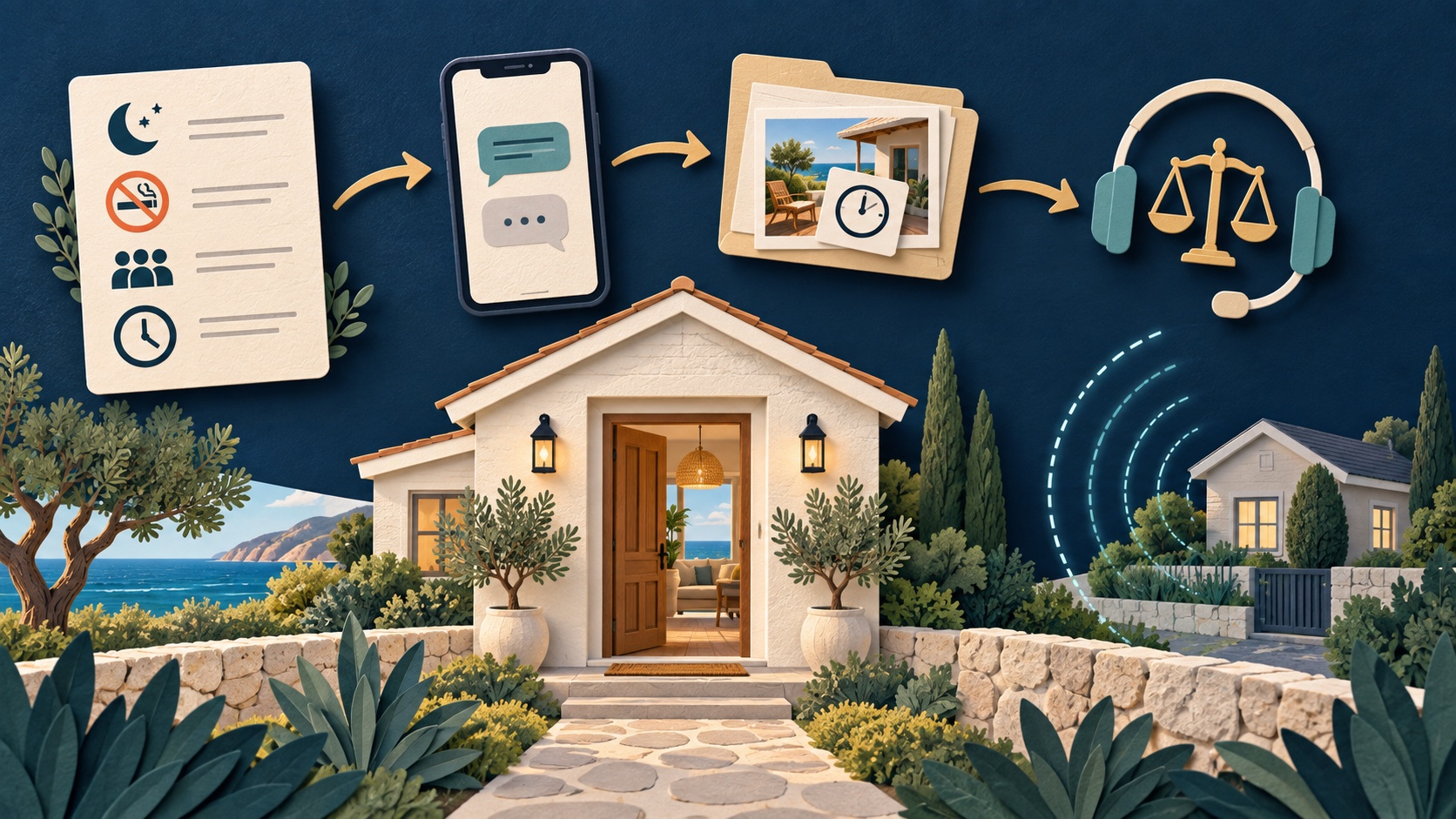
To enforce vacation rental house rules fairly, make the rule visible before booking, confirm the facts, contact the guest promptly, request one specific corrective action, document the exchange, and escalate only when the behavior continues or creates an immediate safety risk. Fair enforcement is consistent, proportionate, privacy-conscious, and based on evidence—not assumptions about the guest.
This guide focuses on what happens after a possible violation. It does not repeat a general list of rules; instead, it gives hosts a practical workflow for noise, unauthorized visitors, smoking, pets, late checkout, property misuse, and related disputes.
What Does Fair House Rule Enforcement Mean?
Fair enforcement means applying a disclosed rule consistently and using the least severe response that can reasonably solve the problem. A minor misunderstanding may need a clarification. A repeated disturbance may require platform support. An active emergency requires local emergency services—not a long message exchange.
Airbnb’s current ground rules for home guests recommend that hosts communicate with the guest, document the issue through the Airbnb message thread or other relevant evidence, contact support when needed, and leave an honest review. That sequence is a useful operational model even when a reservation comes from another channel.
Five principles of a defensible process
- Notice: the guest could reasonably see the rule before agreeing to the reservation.
- Verification: the host checks the source and context before alleging a violation.
- Specificity: the message identifies the behavior, relevant rule, and requested correction.
- Proportionality: the response matches the seriousness, repetition, and risk.
- Consistency: comparable cases receive comparable treatment regardless of who the guest is.
Separate House Rules From Instructions and Laws
A house rule is a condition of using the property, such as quiet hours, maximum occupancy, smoking restrictions, pet rules, parking boundaries, or limits on events. An instruction explains how to perform a task, such as where to place trash or how to operate a thermostat. A law or building rule is an external requirement that may apply regardless of whether it appears in the listing.
This distinction matters during enforcement. A guest who cannot find an unusually complex trash process may need clearer instructions, not a threat. A prohibited party or dangerous act may require immediate intervention because it affects neighbors and safety. Do not present personal preferences as legal mandates.
On Airbnb, standard house rules appear in the listing, booking terms, automated emails, and Arrival Guide. Airbnb’s house-rule setup guidance recommends avoiding an overwhelming list and states that additional rules should not contradict standard rules.
Use a Three-Level Enforcement Framework
Level 1: Clarification or minor correction
Use a calm reminder when the situation appears limited, accidental, and reversible. Examples include a vehicle parked in the wrong designated space, a quiet-hours misunderstanding, or a checkout question. State the observable fact and ask for a specific action.
Message template: “Hi [Guest name], I wanted to check in because [specific observation] appears inconsistent with the house rule about [rule]. Please [specific corrective action] by [reasonable time]. If anything is unclear or you need help, reply here and I’ll assist.”
Level 2: Documented warning and platform support
Use a formal warning when the behavior continues after a reminder, affects neighbors, risks damage, or involves a material booking condition such as occupancy. Keep the conversation on the booking platform when possible. Summarize any phone call in writing afterward.
Message template: “Hi [Guest name], the issue reported at [time] is continuing after our earlier message. The reservation rule requires [requirement]. Please correct this now and confirm in this message thread. If it continues, I will contact the booking platform for next steps.”
Level 3: Safety response or formal escalation
Escalate urgently when there is a credible threat to people, fire risk, violence, unlawful activity, serious property damage, an uncontrolled disturbance, or refusal to stop a material violation. Contact emergency services first when an emergency is in progress. Follow the platform’s process before attempting to end a reservation or enter the property, except where applicable law and immediate safety duties permit otherwise.
Airbnb’s Community Disturbance Policy prohibits disruptive gatherings, excessive noise, trespassing, smoking nuisances, parking nuisances, vandalism, and other serious neighborhood impacts. Airbnb directs people to local emergency services when an emergency is underway.
Step-by-Step Response to a Possible Violation
- Check the reservation record. Confirm the booked guest, dates, declared guest count, disclosed pets, relevant rule, and message history.
- Assess urgency. Decide whether this is an instruction problem, a rule problem, property damage, or an immediate safety issue.
- Verify the signal. Review the source without assuming that one alert or complaint proves what happened.
- Preserve original evidence. Save the timestamp, platform message, permitted device alert, complaint, photograph, or maintenance report.
- Contact the booking guest. Describe the observable behavior rather than assigning motive.
- Ask for one clear action. Examples: reduce noise now, move vehicles, confirm the number of people present, or stop smoking.
- Set a reasonable response time. Urgent disturbances need a fast reply; a routine checkout issue may allow more time.
- Recheck the situation. Confirm whether the corrective action worked using lawful, disclosed methods.
- Escalate proportionately. Contact platform support, a local responder, property staff, or emergency services as the facts require.
- Close the record. Note the resolution, any damage, expenses, refunds, follow-up, and review decision.
How to Document Without Violating Guest Privacy
Good evidence is relevant, timestamped, and obtained lawfully. It may include platform messages, photographs of damage after access is legally permitted, a written neighbor complaint, a cleaner’s condition report, smart-lock events, invoices, or alerts from a properly disclosed device.
Do not install hidden cameras, record private conversations, or enter the property simply to gather evidence. Airbnb’s current device policy prohibits cameras and recording devices that monitor indoor home spaces. It permits disclosed exterior cameras and disclosed noise decibel monitors subject to location restrictions and applicable law. Noise monitors assess sound level and duration; they must not record audio.
If you use a noise-monitoring device, create an alert workflow before a reservation occurs. Our guide to noise monitoring devices for Airbnb explains disclosure, placement, thresholds, and human review.
Build an incident timeline
Use a simple chronological record:
- Date, local time, property, and reservation code.
- Source of the report or alert.
- Exactly what was observed—not what was assumed.
- The rule or policy connected to the behavior.
- Messages sent and guest responses.
- Actions taken by staff, support, or local services.
- Whether the problem stopped and when.
- Damage, cleaning, repair, refund, or neighbor follow-up.
Practical Examples
Noise during quiet hours
A single elevated sound alert may come from a dropped object, television scene, or brief arrival. Verify duration and pattern, then message the guest without claiming that a party is occurring. If a neighbor reports continuing disruption or repeated alerts confirm it, issue a documented warning and contact platform support if the guest does not respond.
Possible unauthorized visitors
Confirm the reservation’s permitted occupancy and distinguish short visitors from overnight occupants if your disclosed rules and local law make that distinction. Ask the booking guest to confirm who is present. Do not infer identity or relationship from appearance. If occupancy creates a safety, permit, or building-capacity issue, explain that concrete limit.
Smoking evidence
During the stay, contact the guest when there is a credible report of active smoking and ask that it stop. After checkout, document odor, residue, ash, burns, or extra remediation before cleaning removes the evidence. An odor statement alone may be less persuasive than a detailed report, time-stamped photos, and a professional remediation invoice.
Late checkout
First confirm the stated checkout time and whether a late departure was approved. Send a practical reminder and explain the operational impact, such as a waiting cleaner or incoming guest. Escalate only if the guest remains unresponsive and access procedures permit staff to act. Do not invent a fee after the reservation; any charge must be disclosed, lawful, and supported by the booking terms.
Pets and assistance animals
Review the platform’s current accessibility and animal policies before contacting the guest. Do not apply a pet rule in a way that conflicts with legal obligations or platform protections for assistance animals. Focus on permitted questions, actual damage, cleanliness, and safety rather than assumptions about disability.
Fees, Damage Claims, and Refund Decisions
A house-rule violation does not automatically create a valid penalty. Separate three questions: Did a violation occur? Did it cause actual damage or extra cost? Does the contract, platform policy, and applicable law allow recovery?
Use the platform’s designated process and submit only accurate, relevant evidence. Do not inflate cleaning or repair costs, reuse old photographs, or describe normal wear as damage. When requesting reimbursement, connect each amount to an invoice, receipt, estimate, or documented labor cost permitted by the platform.
PainHost’s Airbnb damage claim evidence guide provides a separate workflow for photographs, timelines, estimates, receipts, and communication. Keep the rule-enforcement record and financial claim aligned, but do not treat them as the same decision.
Apply Rules Consistently and Without Discrimination
Enforce behavior-based rules against the same observable standard. Maximum occupancy, quiet hours, smoking limits, and parking boundaries should not change because of a guest’s race, nationality, religion, disability, sex, gender identity, sexual orientation, age, or other protected characteristic.
Airbnb’s Nondiscrimination Policy, updated in March 2026, prohibits imposing different terms, conditions, or house rules based on protected characteristics. Local fair-housing and consumer laws may add requirements. Train co-hosts, cleaners, security providers, and managers to report behavior objectively.
Use neutral incident language
Write “The exterior decibel monitor recorded a sustained threshold alert between 11:18 p.m. and 11:34 p.m.” rather than “These guests are party people.” Write “Two vehicles are parked outside the marked spaces” rather than speculating about who owns them. Neutral language improves decision quality and makes records easier for support staff to evaluate.
How to Handle Neighbor Complaints
Give neighbors one monitored contact method and define what information helps: property address, time, observable issue, and whether there is an immediate danger. Acknowledge the report without promising a specific punishment before checking the facts.
Neighbor response template: “Thank you for letting us know. I have recorded the time and details and am checking the active reservation now. If there is an immediate threat to anyone’s safety, please contact local emergency services. I will follow up once the situation is addressed.”
Track complaints by category and time. Repeated parking or noise incidents may reveal a weak listing description, unrealistic occupancy, missing arrival instructions, or a property feature that needs improvement—not merely “bad guests.”
After the Stay: Reviews and Operational Follow-Up
Leave a factual review about behavior you personally observed or can reliably document. Avoid insults, diagnoses, retaliation, or claims you cannot support. Describe the relevant communication and whether the guest corrected the issue.
For response examples and review mistakes, see how to respond to negative Airbnb reviews. Then update the operation: clarify a confusing rule, change the message timing, adjust a device threshold, improve signage, or revise the escalation roster.
House Rule Enforcement Checklist
- Publish concise rules before booking and keep additional rules consistent with standard rules.
- Repeat only the most important rules in pre-arrival communication.
- Disclose permitted monitoring devices exactly as required.
- Define minor, material, and emergency incidents.
- Assign one decision-maker for each active incident.
- Keep messages on the booking platform when possible.
- Use observable facts and neutral language.
- Ask for one specific corrective action and response time.
- Preserve original, timestamped evidence.
- Apply rules consistently and follow nondiscrimination requirements.
- Use platform support and emergency services for their proper roles.
- Separate rule enforcement from damage reimbursement.
- Record the outcome and improve the workflow after each incident.
Frequently Asked Questions
Can a host remove a guest for breaking house rules?
A serious or repeated violation may justify seeking to end a reservation, but the host should follow the booking platform’s process, contract, and applicable law. Contact support before taking action unless there is an emergency requiring immediate local assistance.
What evidence is useful for a house-rule violation?
Useful evidence can include platform messages, a written neighbor complaint, permitted device alerts, lawful access records, time-stamped photographs, inspection notes, and invoices. Evidence should relate directly to the reported behavior.
Can hosts charge an automatic fine for every rule violation?
Do not assume so. A disclosed rule is not automatically an enforceable financial penalty. Charges depend on the agreement, platform policy, actual costs, consumer law, and local requirements. Use the platform’s authorized payment or claim process.
Should hosts call the guest before messaging?
A call can resolve an urgent issue quickly, but send a written summary through the booking platform afterward. Written records reduce confusion about what was reported, requested, and agreed.
Can a noise monitor prove that a party happened?
No. A decibel monitor can show sound level and duration, not the source or identity of the people involved. Treat an alert as a signal to review, communicate, and gather context.
How should a host respond when the guest denies the violation?
Recheck the source, share the observable facts without exposing unnecessary personal data, and ask for a practical corrective action. If the evidence remains uncertain, avoid presenting an allegation as proven and seek platform guidance.
Final Recommendation
The strongest way to enforce vacation rental house rules is a calm, documented, and proportionate process. Make important rules visible, verify before accusing, communicate through the reservation record, protect privacy, and reserve severe action for repeated, material, or dangerous conduct. Consistency protects guests, neighbors, staff, and the host’s ability to explain every decision.
Strengthen prevention before the next reservation by reviewing PainHost’s guides to guest screening for short-term rentals and smart-lock access management.
Artigos Relacionados



Sobre o Autor

0 Comentários